Code Ownership Is a Core Delivery Requirement
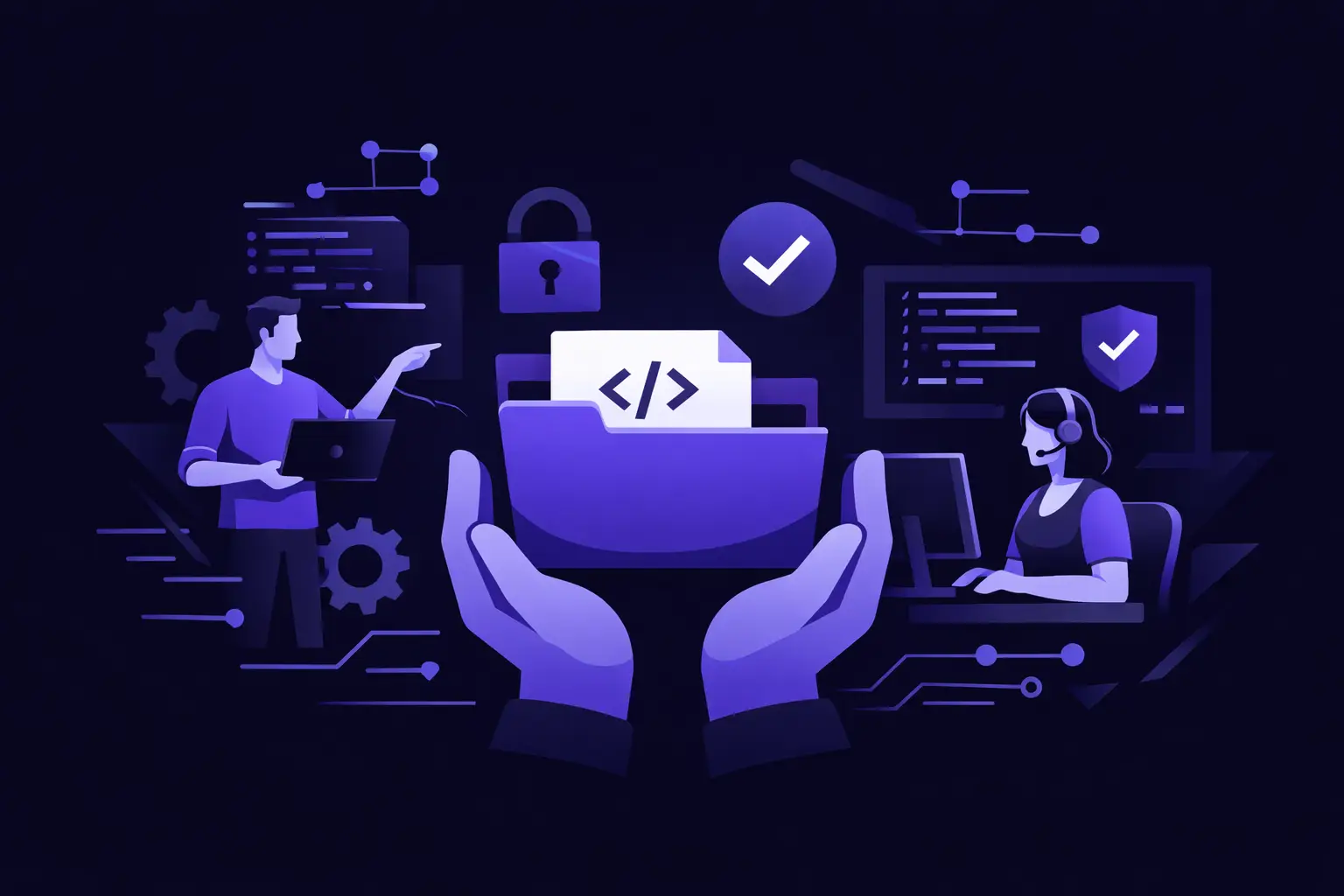
A launch date is not a handover date if the client cannot access the codebase, deployment accounts, database schema, or operating documentation without asking the delivery team for permission. That distinction is where code ownership becomes commercial, not merely technical. For agencies, it protects the client relationship and the margin around it. For founders, it protects the product asset they are paying to create.
Many development engagements promise ownership in broad language, then retain the controls that make ownership usable. The vendor hosts the repository. The production environment sits in its cloud account. Critical API keys belong to an employee’s mailbox. The database structure is undocumented. The project may technically be yours, but operating it independently is difficult, slow, and expensive.
Production software should not create that dependency by accident. Ownership must be designed into the delivery model from the first technical decision through repository handover.
What code ownership actually means
Code ownership is the client’s practical and legal ability to control, modify, deploy, secure, and transfer the software after delivery. Source files are part of it, but they are not the full package.
A complete handover gives the buyer control of the application repository, commit history, branches, infrastructure configuration, environment variables, database migrations, deployment workflow, technical documentation, and credentials or credential-transfer process. It also clarifies who owns the custom interface, backend logic, data model, tests, and project-specific design system work.
This matters because software is not a static deliverable. It is an operating system for a business process, product, or client service. A clean repository without the migration history may leave a future team unable to reproduce the database. A repository without deployment access may leave the original provider as the only team capable of shipping a fix. A handover without tests makes changes riskier than they need to be.
Repository access is not enough
Being added as a repository administrator is useful, but it does not by itself establish usable ownership. The buyer should know where production runs, how releases move from a pull request to deployment, and what third-party services are required to keep the product working.
For a React, NestJS, and PostgreSQL application, that usually means access to the frontend and API repositories, the PostgreSQL instance or backup process, migration scripts, CI/CD configuration, hosting accounts, domain settings, error monitoring, transactional email, storage, and payment or authentication integrations where applicable. The exact stack changes, but the principle does not: the system must be transferable without reconstruction.
Legal ownership and operational control must match
Contracts should state that the client receives rights to the custom work created for the engagement. But legal language cannot compensate for operational lock-in. If a client owns the code but cannot obtain the deployment configuration, the right exists without the control needed to use it.
The strongest arrangement aligns both. The contract assigns the relevant intellectual property, and delivery is organized so the client or agency can take control at the agreed handover point. That means ownership is visible in the workflow, not buried in a final PDF.
Why code ownership protects agencies and founders
For an agency, the risk is not only technical. A hidden engineering partner must remain invisible by contract and by process. If that partner controls the code repository, cloud accounts, or client credentials, the agency has less control over its own account. A difficult maintenance request can expose the dependency. A future rebuild can become a negotiation with the very supplier the agency needs to keep behind the scenes.
Agency partners need a structure that preserves client ownership, agency control, and delivery accountability at the same time. The agency should be able to present the completed system, manage the relationship, and choose whether the next phase is handled by the same engineering team or another one. Your client never sees the engineering layer unless the agency decides otherwise.
For founders, the stakes are more direct. The codebase is often the first meaningful asset of the company. Investors, acquirers, senior hires, and future technical partners will assess whether the product can be maintained and extended without a single outside vendor holding the keys.
A founder who accepts a disposable prototype may reach an early demo faster, then discover that the product has no tested API boundaries, no reliable relational model, and no understandable release process. That is not always wrong. A throwaway prototype can be rational when learning is the only goal. But it should be labeled and priced as temporary work, not sold as a scalable software asset.
The code ownership terms to define before work starts
Ownership should be settled during scoping, while the architecture and commercial boundaries are still clear. A fixed-scope, fixed-date project is easier to govern when both sides know exactly what will be delivered and what remains outside the engagement.
The agreement should address at least these five areas:
- Custom source code and assets: Define which project-specific code, schemas, tests, and interface assets transfer to the client or agency at payment and handover.
- Repository control: Establish where the repository lives, who has administrative access, and when the buyer receives full control. A buyer-owned organization from day one is often the cleanest option.
- Infrastructure and credentials: Specify which accounts are buyer-owned, which credentials will be transferred, and how secrets are managed without placing them in source control.
- Reusable vendor components: Identify any pre-existing utilities, internal accelerators, or licensed packages that remain with the engineering provider. This is normal when disclosed clearly.
- Handover acceptance: Define the materials, access, and verification steps required before the project is considered complete.
The fourth point deserves attention. Requiring every engineering provider to transfer every internal helper is neither realistic nor necessary. A development team may use generalized lint rules, internal templates, deployment scripts, or non-client-specific utilities across projects. The issue is not reuse. The issue is whether the delivered product depends on something the buyer cannot legally use, inspect, or replace.
The clean rule is simple: custom work built for the project belongs with the project. Pre-existing components can remain licensed or excluded when they are documented, non-critical to independent operation, and not represented as custom deliverables.
Handover should be a controlled engineering event
A proper handover is not a zip file sent after the final invoice. It is a short, verifiable transfer process.
The delivery team should confirm that the repository contains current source code, lockfiles, migration history, environment templates, test instructions, and a readable setup guide. The buyer should be able to clone the project, install dependencies, run the test suite where applicable, and understand how local, staging, and production environments differ.
For production systems, documentation should also explain the data model at an appropriate level, key API flows, user roles, background jobs, scheduled tasks, third-party dependencies, and release procedure. It does not need to become a 100-page architecture manual. It needs to give a competent future team a reliable starting point.
Access transfer requires equal discipline. Move domains, cloud resources, analytics, monitoring, email services, storage, and payment accounts into buyer-controlled organizations where practical. Rotate secrets after transfer. Remove unnecessary vendor access while preserving the access needed for any agreed support period.
This process protects the delivery team too. Clear acceptance criteria prevent the vague, expensive pattern where a completed project turns into unlimited post-launch questions. Handover should create a clean boundary: the product is delivered, the client controls it, and any further work is scoped as a new phase.
Ownership does not remove the need for support
Some buyers hear “full ownership” and assume they must immediately operate the system alone. That is not the point. A reliable engineering partner can continue to maintain, improve, and scale the product after handover. The difference is that the client stays by choice, not because leaving is operationally impossible.
There are reasonable exceptions. A managed platform may require a vendor account. A licensed service may have non-transferable terms. A white-label agency may prefer the agency to hold the repository while its end client receives rights under the agency agreement. These are workable structures when everyone understands them before development begins.
What should not be acceptable is ambiguity. If a provider says the code is yours, ask where it will live, who will administer it, what access transfers, and what a new engineering team would need on day one. The answers reveal whether the engagement is built for control or for dependency.
The best time to protect a software asset is before the first commit. Put ownership, access, and handover into the scope with the same precision used for features and launch dates. Then the product can survive success, team changes, and the next phase of growth without asking anyone for the keys.
Need this built for you?
Start a project