How to Validate SaaS Architecture Before You Build
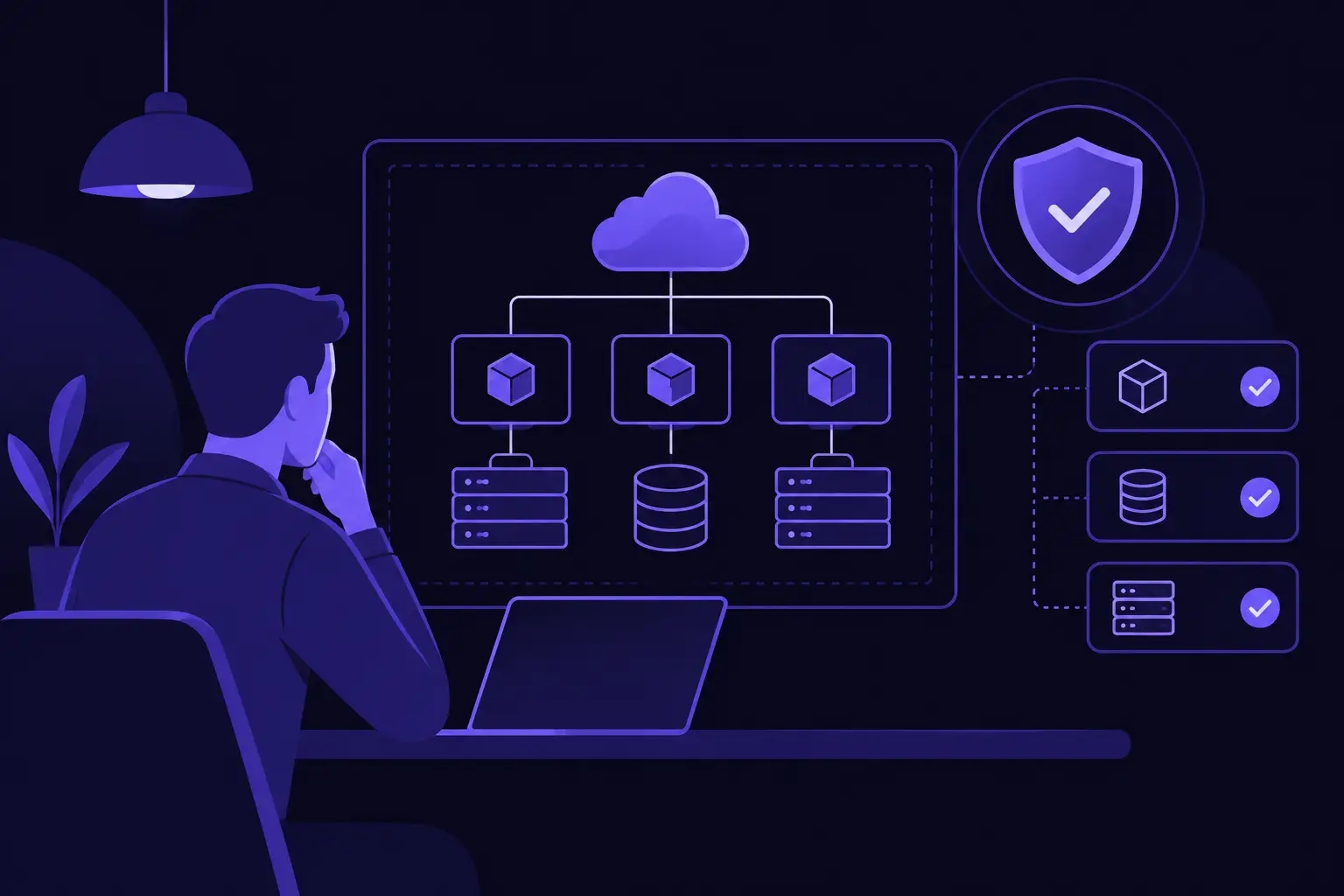
A SaaS product can look convincing in a prototype and still fail its first serious customer. The failure usually appears where demos do not: a tenant sees another tenant’s data, a pricing change breaks permissions, reporting times out, or a simple integration turns into a rewrite. Knowing how to validate SaaS architecture before development is how agencies and founders avoid selling a product promise the system cannot safely support.
Architecture validation is not a ceremony for producing diagrams. It is a focused technical and commercial test: can this system support the product model, the operating model, and the likely next stage of revenue without creating an expensive escape route later?
Start with the business rules, not the technology
React, NestJS, PostgreSQL, and strict TypeScript are capable tools. They do not decide whether your SaaS model makes sense. Validation begins by making the product’s non-negotiable rules explicit.
Ask what a customer account actually owns. Is the tenant a company, a workspace, a franchise, or an individual user? Can one user belong to multiple organizations? Do teams have roles that vary by project, location, or account? Is billing tied to seats, usage, transactions, records, or a fixed plan?
These questions are not product-management extras. They determine the data model, authorization strategy, API boundaries, and testing requirements. If the answers are vague, the architecture is not ready to validate because the system is still being asked to enforce undefined rules.
For agencies, this stage also protects the client relationship. A vague feature request such as multi-location access can conceal a large permissions problem. Resolve it before the scope is fixed, not after the client has been promised a launch date.
Turn assumptions into testable statements
Write the most consequential assumptions as statements that can be proven or rejected. For example: an account owner can invite a manager, a manager can only view assigned locations, and no request can retrieve records outside the active organization.
Then add operational statements: an administrator can export their organization’s data, a canceled subscription preserves data for a defined retention period, and an audit record exists for sensitive changes. Each statement should map to a user flow, endpoint behavior, database constraint, or automated test.
This exposes a common problem early: teams often have screens designed for permissions that have never been specified in a way the backend can enforce.
Validate the SaaS data model and tenancy boundary
A relational database should model the relationships that matter, rather than hide them in loosely structured fields. PostgreSQL works especially well for SaaS products when organizations, memberships, roles, subscriptions, and domain records have explicit relationships and constraints.
The central question is tenancy. How will the system guarantee isolation between customers? For many early-stage SaaS products, a shared database with a tenant or organization identifier on tenant-owned records is the practical choice. It keeps operations manageable while supporting growth. But it only works when that identifier is enforced throughout queries, writes, background jobs, exports, and administrative tools.
A column alone is not isolation. Validate that every route derives the active tenant from authenticated context, not from a client-supplied value that can be altered. Confirm that database queries consistently scope records and that service-layer methods cannot bypass the rule accidentally.
Separate databases or schemas may be justified for regulated industries, contractual isolation requirements, or unusually large enterprise accounts. They add operational cost, migration complexity, and reporting challenges. The right choice depends on the customer contract and risk profile, not on a preference for architectural spectacle.
Check the relationships that create future pain
Review the entities likely to change as the product gains traction: users and organizations, roles and permissions, plans and entitlements, records and attachments, and integrations and sync events. Look for assumptions that prevent legitimate future states.
For instance, a user table with one organization identifier blocks consultants, parent companies, and multi-workspace users. A subscription field on the organization may be adequate initially, but it becomes limiting if billing history, plan changes, invoices, or usage limits must be retained. Do not overbuild every possibility. Build clean extension points where the roadmap has credible pressure.
Test authorization as a system, not a screen
Many SaaS teams validate authentication and stop there. Login is not authorization. The more meaningful test is whether every action is permitted for the right actor, on the right resource, within the right tenant.
Define roles in terms of capabilities, not page access. A role may create projects, approve requests, manage members, or view financial reports. The API should enforce those capabilities regardless of what the front end displays. Hiding a button is a usability measure, not a security control.
A strictly typed standard helps here. Shared TypeScript contracts can make invalid request shapes and missing states harder to introduce. They cannot replace server-side authorization checks, but they reduce drift between the interface and the API.
Validate negative cases deliberately. Try to retrieve another organization’s record by identifier. Try to submit a request with a modified organization ID. Try to call an endpoint directly when the interface would normally hide it. If those paths are not tested, the architecture has only been validated for cooperative users.
Validate scale through failure paths and real workloads
Early architecture does not need to prove it can serve millions of users. It needs to prove that growth will not demand a reckless rewrite. Focus on the workloads that carry cost or risk: large lists, search, reporting, file processing, external API synchronization, bulk imports, and notification delivery.
Ask where work happens when a request should not wait. A user should not need to hold an HTTP connection open while the system processes a large CSV file or synchronizes thousands of records. Those jobs need a defined queueing and retry approach, with visible status and safe handling for duplicate execution.
Then inspect the database path. Are the most common filters and joins supported by indexes? Does pagination avoid loading an entire table? Can a report query be isolated from transaction-heavy workflows? A few representative queries and realistic sample volumes reveal more than broad claims about scalability.
Third-party dependencies deserve the same scrutiny. Validate rate limits, failed webhooks, partial syncs, credential rotation, and vendor downtime. If the product depends on an external platform, define what the user sees when that platform is unavailable. Silence is not a recovery strategy.
Validate operability before the first customer needs support
Production architecture includes the ability to understand what happened. A founder needs to know why an import failed. An agency needs a dependable answer when its client reports missing data. That requires structured logs, meaningful error states, request correlation, monitoring for critical failures, and an audit trail where the domain warrants one.
Set acceptance criteria for deployment and recovery. Can the database be backed up and restored? Are migrations reversible or at least safely forward-only? Are environment variables documented? Can a new engineer run the application locally without tribal knowledge? These questions are less glamorous than a feature demo, but they determine whether the product remains an asset after launch.
Repository ownership belongs in the validation process as well. If the client cannot access the source code, deployment configuration, and technical documentation, they do not fully control what they paid to build. Handover is an architectural concern because operational continuity depends on it.
How to validate SaaS architecture with a proof plan
Do not approve architecture from a diagram alone. Create a short proof plan around the highest-risk flows. For a B2B application, that may include organization creation, member invitation, role enforcement, a tenant-scoped report, a billing event, and a failed integration retry.
Build thin vertical slices of these flows through the interface, API, database, and tests. This is more useful than building a broad but shallow MVP because it proves that the critical boundaries work together. Where a risk cannot be fully built yet, document the decision, its owner, the trigger for revisiting it, and the expected cost if the assumption proves wrong.
A practical validation review should leave with clear answers to four questions:
- Which business rules are enforced in code and data constraints?
- Which customer data can each role access, and how is isolation tested?
- Which workloads move outside the request cycle, and how do they recover from failure?
- What does the owner receive to operate, extend, and transfer the product?
If the team cannot answer these precisely, the scope is not stable enough for a fixed date.
Treat validation as protection for the launch date
The goal is not to create enterprise complexity before revenue. It is to remove the architectural shortcuts that turn a successful launch into a liability. A smaller, well-bounded product with clear tenancy, tested permissions, sound relational modeling, and recoverable operations is usually the better commercial decision.
NovaStack applies this discipline before and during delivery because fixed scope only works when the system’s critical rules are understood. The code should be yours, the repository should be usable, and the foundation should be built to survive success.
Before approving the build, ask one final question: if the first ten paying customers arrive with slightly different needs, will the team extend the product through defined rules, or work around a structure that was never validated? The answer is often the most useful architecture decision you can make.
Need this built for you?
Start a project