PostgreSQL Versus MongoDB for Production Apps
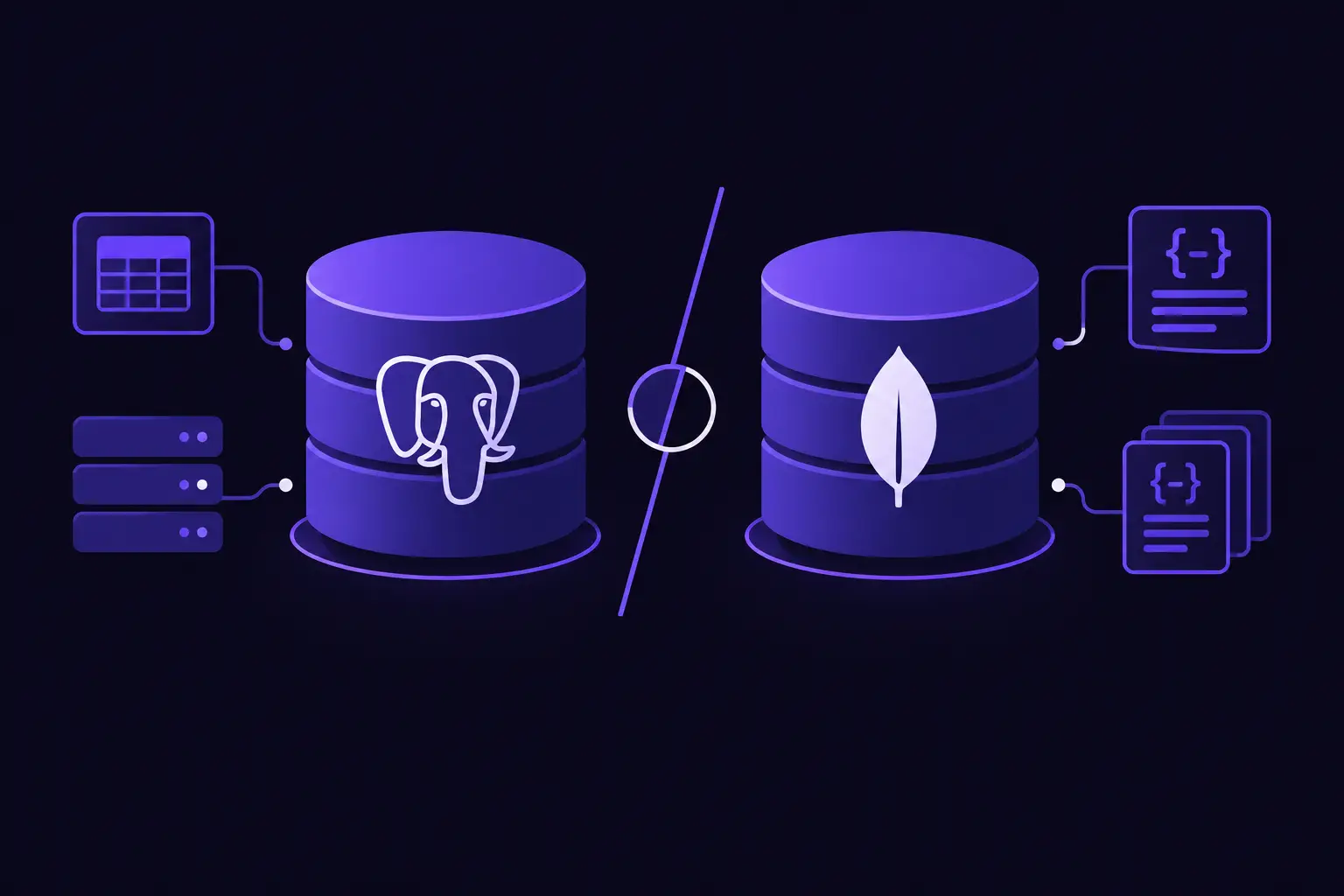
A database choice becomes expensive when it is made to accelerate a demo rather than support the business behind it. PostgreSQL versus MongoDB is not a contest between old and new technology. It is a decision about how your product represents truth, handles change, and behaves when real customers, teams, permissions, and financial consequences arrive.
For agencies shipping client platforms and founders building SaaS products, the question is usually not whether either database can store the data. Both can. The useful question is whether the application has relationships and rules that must remain correct under pressure. If it does, the database should enforce more than convenient storage.
PostgreSQL Versus MongoDB Starts With the Data Model
PostgreSQL is a relational database. Information lives in tables, and relationships are expressed through foreign keys, joins, constraints, and transactions. A user can belong to an organization, hold a role, create invoices, approve records, and access only certain projects. PostgreSQL is designed for that shape of system.
MongoDB is a document database. It stores flexible JSON-like documents in collections. This is a natural fit when records vary substantially, are mostly retrieved as complete objects, and do not require frequent multi-record coordination. A product catalog with inconsistent attributes, a content payload, or high-volume event data can be modeled cleanly as documents.
The difference is not that PostgreSQL cannot store flexible data or that MongoDB cannot support relationships. PostgreSQL offers JSONB for semi-structured fields, while MongoDB supports references and transactions. The distinction is where each system creates the least friction.
PostgreSQL makes structure and cross-record integrity first-class concerns. MongoDB makes evolving document shape and denormalized reads more convenient. Choosing well means modeling the product you expect to operate in 12 or 24 months, not only the screen you need to show next Friday.
Where PostgreSQL Earns Its Place
Most operational SaaS products are relational, whether the first wireframes reveal it or not. Multi-tenant access, subscriptions, order workflows, audit trails, team permissions, inventory, approvals, reporting, and integrations all introduce connected records. They also introduce failure states that should not be possible.
Consider a platform that allows an account owner to invite users, assign them to client accounts, and approve payable invoices. A production-grade implementation needs to answer precise questions: Can a user access this client? Can an invoice be approved twice? What happens if payment capture succeeds but an account update fails? Can an agency administrator view one client’s data without seeing another’s?
PostgreSQL gives the engineering team strong tools for these rules. Foreign keys prevent orphaned records. unique constraints prevent duplicate states. Transactions allow several dependent changes to succeed together or fail together. Isolation controls help prevent race conditions when several users act on the same data at once.
That matters commercially. A database constraint is less negotiable than a convention in application code. It protects data even when a new endpoint is added, a background job is retried, or a future developer misunderstands an edge case. For products expected to survive success, integrity belongs in the architecture, not only in a ticket description.
PostgreSQL also works well with a strictly typed TypeScript stack. A clear schema creates a reliable source for API contracts, migrations, validation, and test fixtures. This does not eliminate engineering judgment, but it reduces the gap between what the product claims to support and what the system can safely store.
When MongoDB Is the Better Fit
MongoDB is not a shortcut by definition. It is a strong choice when the document is genuinely the unit of work.
A knowledge base with deeply nested page blocks, an application that captures highly variable form submissions, or a telemetry pipeline receiving changing payloads may benefit from document storage. The ability to add fields without coordinating a broad relational migration can be valuable when variation is expected rather than accidental.
It can also simplify reads when an application commonly fetches one self-contained aggregate. If a configuration object is loaded, edited, and saved as a whole, embedding related values in a document can be clearer than distributing them across many tables.
The caution is denormalization. Copying data into multiple documents can make reads fast and implementation direct. It also creates a synchronization obligation. If a customer name, entitlement, or permission changes in five places, the system needs a deliberate method for keeping every copy correct. That is manageable in the right domain. It becomes costly when the product evolves from simple content storage into a system of record.
MongoDB transactions are available and can protect multi-document work. But if transactions, reference lookups, and consistency workflows become central to the design, that is usually a signal to reconsider whether the document model is carrying too much relational responsibility.
Schema Flexibility Is Not the Same as Schema Freedom
Teams often describe MongoDB as schema-less. In production, that phrase can create false confidence. Every serious product has a schema, whether it is enforced by the database, an ORM, API validation, TypeScript types, or a collection of undocumented assumptions.
The real choice is where enforcement happens and how reliably changes are managed. PostgreSQL asks teams to make data structure explicit. That can feel slower during early development, particularly when requirements are unclear. In exchange, it makes migrations visible, reviewable, and repeatable.
MongoDB lets teams evolve documents more gradually, but the application still needs to support old and new document versions during a transition. Without disciplined validation and backfill routines, flexible collections can accumulate records that look similar but behave differently. That is not agility. It is deferred data cleanup.
For an MVP, use flexibility where uncertainty is real. Store evolving questionnaire answers or provider payloads in JSONB or documents. Keep the core entities that define ownership, money, permissions, and workflow state under clear constraints. A hybrid approach inside PostgreSQL is often sufficient: relational tables for the product’s source of truth, JSONB for bounded variable attributes.
PostgreSQL vs. MongoDB for Scale
Neither database should be selected because of a generic claim that it “scales.” Scale has a workload.
MongoDB is well suited to horizontal distribution patterns and high-throughput document workloads. Its flexible documents can be effective when large volumes of similarly accessed records must be stored and retrieved quickly. It is a reasonable candidate for event ingestion, logs, content documents, and certain real-time workloads.
PostgreSQL scales far beyond the needs of many SaaS applications through indexing, query tuning, read replicas, partitioning, caching, and carefully designed queries. It is especially effective when the business needs accurate reporting and consistent writes. The bottleneck is often not raw database capacity. It is unbounded queries, missing indexes, chatty APIs, or a data model that does not match the product.
Sharding is not a badge of maturity. It adds routing, operational overhead, cross-shard constraints, and more difficult incident response. Do not adopt it because the architecture diagram looks enterprise-ready. Adopt it when measured load and a defined access pattern require it.
For most agency-delivered portals and early-stage SaaS products, the immediate engineering priority is a dependable transactional core, tested endpoints, observability, and a migration path that does not require rewriting the product after launch. PostgreSQL is frequently the lower-risk default for that work.
Delivery Risk Should Influence the Decision
Database selection affects scope control. A data model with ambiguous ownership and weak constraints creates uncertainty in API behavior, QA coverage, estimates, and handover. That uncertainty eventually reaches the client as change requests, delayed launches, or defects that only appear after live data arrives.
A fixed scope and date do not require a rigid product. They require explicit decisions about what is stable, what is variable, and what the system must never allow. The database is part of that contract.
For white-label agency work, this is particularly relevant. Your client never sees the engineering layer, but they will experience the consequences of its decisions. A clean relational foundation makes it easier to hand over a repository that another team can inspect, extend, and own. For founders, it protects the asset being built: the code is yours, and the underlying data should not depend on undocumented behavior to remain correct.
NovaStack Agency generally favors PostgreSQL for transactional SaaS and custom business systems because relational architecture aligns with the applications clients most often need to run. That is a default, not a dogma. The right design can include document-oriented patterns where the domain warrants them.
Make the Choice From Future Operations
Choose PostgreSQL when the product centers on connected entities, permissions, financial events, workflow states, reporting, or auditability. Choose MongoDB when documents vary materially, are used as complete aggregates, and the cost of cross-document consistency is low and understood.
Before committing, ask the questions that a launch plan cannot avoid: What data must never be duplicated or lost? Which actions must happen together? Which reports will operators need when revenue, users, and exceptions increase? What will a new engineer need to understand six months after handover?
The best database decision is rarely the most fashionable one. It is the one that makes correct behavior easier to build, test, explain, and maintain when the product is no longer a prototype.
Need this built for you?
Start a project