Project Outsourcing Versus Hiring Developers
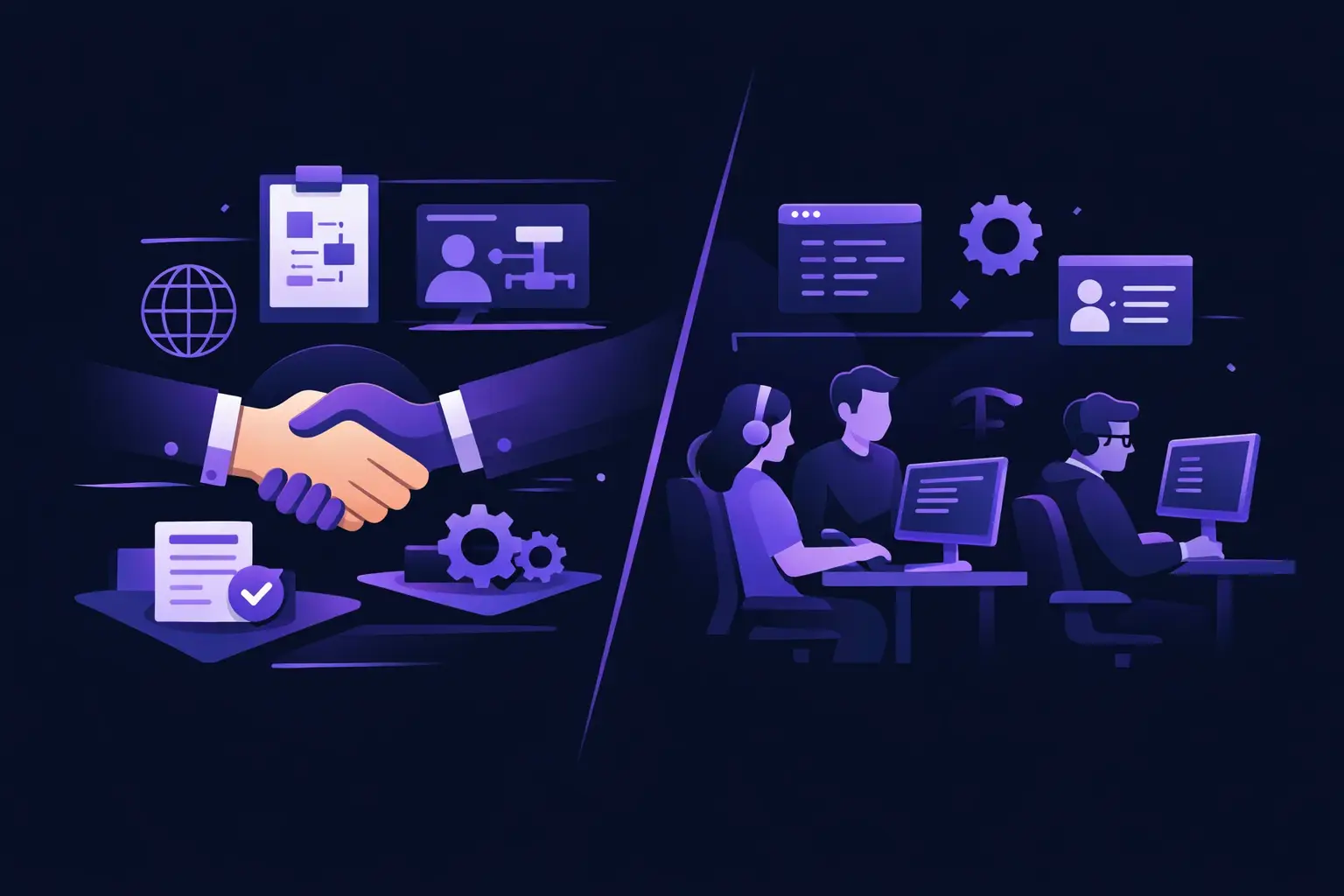
A client approves a complex portal, a founder needs an MVP before a funding conversation, or an internal system has reached the point where spreadsheets are no longer safe. The question is rarely whether engineering is needed. It is whether project outsourcing versus hiring developers gives you the cleaner commercial and technical path.
For agencies, the wrong choice can erode margin, delay a launch, or expose a client relationship. For founders, it can turn a defined product build into months of recruiting before a single production endpoint exists. The right model depends on the durability of the need, the clarity of the work, and how much delivery risk you are prepared to manage directly.
Project outsourcing versus hiring developers: the real distinction
The difference is not simply external people versus internal people. It is ownership of the delivery problem.
When you hire developers, you build internal capacity. You own recruiting, compensation, onboarding, engineering management, tooling, performance reviews, and the cost of idle time between projects. In exchange, you gain a team that can accumulate product context and remain available for changing priorities.
When you outsource a project, you buy a defined engineering outcome from a delivery partner. A proper engagement states what will be built, what will not be built, how acceptance works, who owns the repository, and when handover occurs. The partner owns execution inside that agreed boundary.
That distinction matters because many buyers try to use one model like the other. They hire a full-time engineer to solve a one-off launch deadline, then have no meaningful backlog after release. Or they retain an external team while changing requirements weekly, expecting the flexibility of an in-house product department under a fixed project budget. Both arrangements create friction because the commercial model and operating behavior do not match.
When hiring developers is the better decision
Permanent hiring makes sense when software is a continuous operating function, not a defined delivery need. If your roadmap changes every week, your product requires daily engineering decisions, and you can keep a strong team fully utilized for the next 12 to 24 months, internal hiring can create compounding value.
The strongest case for hiring appears after a product has active users, a validated direction, and a steady flow of improvements. Your team learns customer behavior, support patterns, technical debt, and the trade-offs behind previous decisions. That context is difficult to transfer and valuable to retain.
Hiring is also appropriate when engineering leadership must sit inside the business. A company building proprietary technology, running sensitive infrastructure, or making frequent architecture decisions may need a technical leader with authority over standards, roadmap sequencing, and team growth. An outsourced team can support that leader, but it should not be asked to replace an absent internal decision-maker forever.
The trade-off is cost and management load. Salary is only the visible number. Add recruiting time, benefits, equipment, payroll taxes, management capacity, contractor overlap during onboarding, and the risk of a bad hire. For agencies, there is another issue: payroll is fixed while client work is not. A quiet quarter does not reduce the cost of an underutilized internal bench.
When project outsourcing is the stronger model
Outsourcing is most effective when the outcome is clear enough to specify and commercially important enough to protect with a fixed scope and date. A customer portal, SaaS MVP, operations dashboard, custom API integration, or complex React front end can all be approached as a defined build rather than an indefinite staffing exercise.
For a creative agency, this model protects the relationship you already own. You can sell the strategy, design, and client communication under your brand, while a confidential engineering partner implements the application layer behind the scenes. Your client never sees the delivery partner, and you do not need to create permanent payroll for skills that may only be needed on selected accounts.
For a founder, outsourcing can compress the period between idea and usable asset. Instead of recruiting individual developers and coordinating their work, you engage a team that can define the architecture, build the interface and API, model the relational database, test the critical paths, and hand over the repository. The objective is not a disposable demo. It is a codebase built to survive success.
This route is especially compelling when time has a business value. Missing a contractual launch date, a seasonal sales window, or an investor milestone can cost more than the apparent savings of a slower, cheaper staffing plan.
Outsourcing is not a shortcut around product decisions. A serious partner still needs timely feedback, a designated approver, access to business rules, and clear acceptance criteria. What it removes is the burden of assembling and supervising a delivery team from scratch.
Compare the cost beyond the hourly rate
Hourly comparisons often produce the wrong answer. A lower rate does not help if the project has no delivery owner, requirements remain undefined, and each developer interprets the work differently.
An internal hire creates a recurring cost whether there is work or not. It can be economical when utilization is consistently high. A project partner usually costs more per hour on paper because the price includes established process, technical leadership, delivery accountability, and access to multiple disciplines. Yet the total cost can be lower when the work has a defined beginning and end.
The more useful calculation is total delivered cost. Include recruiting, ramp-up, management time, rework, missed deadlines, quality assurance, deployment, and post-launch stabilization. Then ask what happens if the first choice fails. Replacing a hire after three months is expensive. Recovering a poorly structured codebase can be worse.
A fixed-scope engagement is valuable because it forces the uncomfortable questions early: Which workflows are essential? What data must be retained? Which third-party systems must connect? What is explicitly outside phase one? That discipline protects budget far better than a vague promise to build until the money runs out.
Control, confidentiality, and ownership
Some buyers assume hiring automatically means control. It does not. A developer working without documented standards, tested endpoints, or clear technical review can create dependency inside your own company. You may hold the employment agreement and still lack control of the system.
Control comes from documented decisions, accessible source code, predictable deployment practices, and ownership that survives a personnel change. Whether you hire or outsource, insist on repository access, clear environment credentials, readable documentation, and a handover process that does not leave the business dependent on one person.
For agencies, confidentiality has its own requirements. The delivery agreement should establish white-label conduct, restricted client contact, and clear communication channels. The engineering partner should not use your account as a lead source or compete for credit after launch. Invisible by contract is not a cosmetic preference. It is how the agency protects trust and margin.
For founders, ownership should be explicit from the first commercial conversation. Clarify who owns the source code, database schema, infrastructure configuration, design assets, and third-party accounts. “Access later” is not the same as ownership at handover.
The technical standard changes the decision
A project is only as outsourceable as its specification and engineering standards. If a partner proposes visual builders for a product expected to handle real workflows, integrations, permissions, and customer data, the short-term speed may create a long-term constraint.
A production-grade build should make deliberate choices about the stack, data model, authentication, validation, error handling, testing, and deployment. For example, a strictly typed TypeScript application with React, NestJS, and PostgreSQL gives a team a coherent path for front-end behavior, API contracts, and relational data integrity. It does not guarantee success by itself, but it reduces avoidable ambiguity as the system grows.
This is where a project partner should be evaluated as a delivery system, not a collection of resumes. Ask how scope is translated into tickets, how edge cases are surfaced, how endpoints are tested, how changes are controlled, and what arrives at handover. NovaStack Agency, for example, is structured around fixed scopes, dates, confidential delivery, and full repository ownership rather than open-ended staff augmentation.
A practical way to choose
Choose hiring when the work is permanent, the backlog is deep, and you have the leadership capacity to manage engineers well. Choose project outsourcing when the deliverable is defined, timing matters, and you need an accountable team without adding long-term payroll.
A hybrid model is often the most commercially sensible option. Use a project team to establish the first production release or clear a complex technical milestone, then hire internally once the product has enough ongoing demand to justify a permanent team. Agencies can use the same approach: keep client strategy and account ownership in-house, then bring in confidential specialist capacity when a build exceeds the internal team’s range or availability.
Before committing, write down the next 12 months of engineering work. Separate it into fixed projects, recurring maintenance, and uncertain ideas. If most of the value sits in a defined launch, buy a defined delivery outcome. If the value sits in continuous discovery and operation, build the internal capability to carry it.
The best decision is the one that leaves you with a working product, a clear owner, and no hidden dependency when the launch date arrives.
Need this built for you?
Start a project